
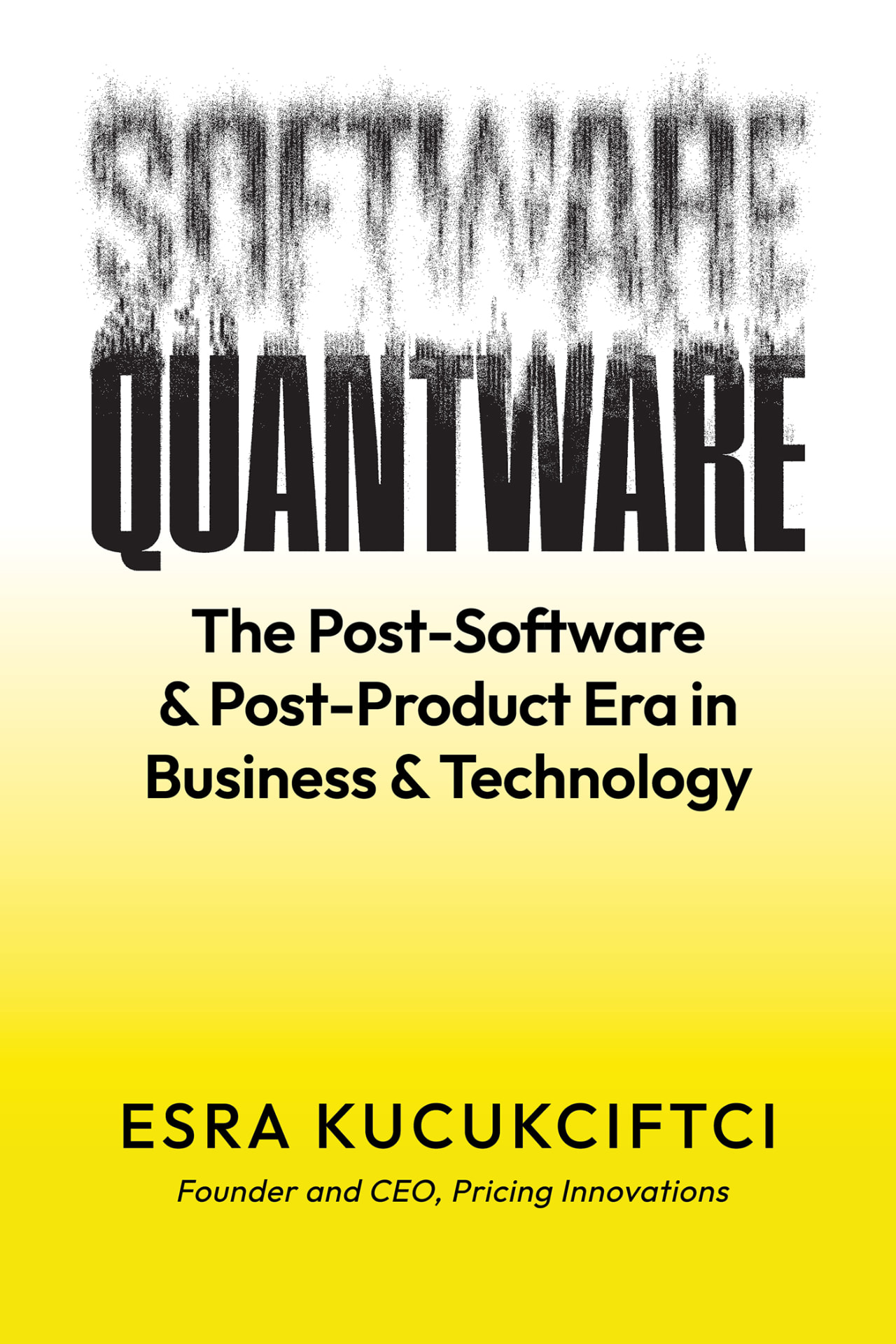
Quantware
The Post-Software & Post-Product Era in Business & Technology.The Post-Software& Post-Product Era inBusiness & Technology.
Esra Kucukciftci
Hardcover and ebook. Published March 9, 2027 by Ideapress Publishing.
Preorder from your bookseller








Who's this book for
Find your way into the book
Choose your role to see the question that brought you here, and what else you'll find answered inside.
01 / 06
Executive leaders
“We are committing millions to AI, yet we cannot show enterprise value or operating margin. How do we move from an ROI we cannot see to ROIS that we can measure?”
You'll also find answers to
- Why is this technology different from the software and why do the instruments that worked then stop working now?
- Which of our businesses does AI expand, and which AI decisions quietly erode our margins?
- Which parts of how we run our firm will break first in the quantware era, and what should replace them?
- Across a portfolio of AI investments, which ones should we fund, hold, reprice, or stop?

About the author
Esra Kucukciftci
Esra Kucukciftci is an author, strategist, and educator, and the Founder and CEO of Pricing Innovations. With a career spanning from 30+ technology domains to artificial intelligence, Esra specializes in how modern businesses evolve, create value, and adapt to technological change. Her work has guided major corporate strategies, mergers and acquisitions, and industry-shaping business models. Before focusing on business strategy and pricing, Esra built a diverse background in technology and product leadership, including roles at Amazon and SAS. She holds a Bachelor of Science in Chemical Engineering from Boğaziçi University in Istanbul, Turkey, and an MBA from the University of Minnesota where she is a lecturer.
esrakucukciftci.comLinkedInSpeaker one sheet
Get in touchBook details
- Format
- Hardcover
- Pages
- 261
- Trim size
- 6 × 9 in
- List price
- $34.95
- Ebook
- $16.99
- ISBN
- 978-1-64687-346-3
- Publisher
- Ideapress Publishing
- Distributor
- Simon & Schuster
- Publication date
- March 9, 2027
Questions about the book
Quantware is written for leaders on both sides of the AI equation: the executives at enterprise firms who buy and govern intelligent systems, and the leaders at AI companies who price, deploy, and scale them. The book addresses three architectural dimensions (commercial, organizational, and operational) and each speaks directly to the leaders who hold those functions. A CFO reading for ROIS and a chief revenue officer reading for RaaS pricing architecture will find distinct, actionable content in the same book.
Both. The commercial architecture in Part 2 is written for vendors building outcome-based contracts and for buyers who govern them. The organizational and operational architecture in Parts 3 and 4 applies equally to the vendor deploying the system and the buyer running the context that makes it work. One of the book's central arguments is that the quantware era places firms on both sides of AI systems simultaneously: buying AI capability from vendors while delivering AI-derived outcomes to their own customers.
Quantware is written for a management audience. The argument is architectural and commercial, directed at the leaders who govern AI systems, price their outputs, and answer to boards for what those systems return. Where AI systems appear in the book, the emphasis falls on what they produce, how that value is measured, and what the firm must build to govern and prove it. Technical practitioners will find the frameworks actionable. The book was designed for the leaders who govern the era alongside the engineers who build it.
Most books on AI in business address what AI can do. Quantware addresses what the firm must build to govern, prove, and scale what it does. The distinction is commercial, organizational, and financial. The frameworks introduced (PROVE, ROIS, RaaS, the node, and NOVA) constitute the management architecture the quantware era demands, independent of any specific technology. The book applies equally to a firm deciding which AI systems to deploy and to a firm deciding how to scale the systems it sells.
Quantware introduces five primary frameworks. Resolution-as-a-Service (RaaS) is the commercial model that replaces SaaS for the AI era, with outcome tiers, outcome-based pricing, and a contract that settles on proof rather than access. PROVE is the specification every outcome is proven against: performance standard, reference intent, observability requirements, value and terms, and evolution mechanism. ROIS, the Return on Intelligent Systems, is the financial instrument that measures what a deployment returned against what it cost to run, in terms a CFO can report to a board. The node is the smallest organizational unit that owns a resolution end to end, governed by four connectors. NOVA, the Network of Orchestration, Value, and Attribution, assembles nodes into the governing architecture of the dynamic firm.
Quantwarebook.com will host the worked templates, interactive tools, and companion resources for the frameworks in the book: guides to outcome pricing, the RaaS map, the PROVE framework, the deployment readiness assessment, the NOVA templates, and the ROIS and VIR worksheets. Book buyers unlock them with their order confirmation number, and each opens as it is published.
Quantware is structured for executive readers with limited consecutive reading time. Each chapter includes emphasis boxes that carry the chapter's core arguments, and navigation markers throughout the text identify new concepts, deeper technical material, and design decisions. A reader who works through the emphasis boxes and chapter openings gains the book's full architectural argument in a focused session. A complete reading of the text and worked examples takes longer, and Part 4 in particular is written for the operational practitioners who will build the instruments the book describes.
Yes. The book is written to be read together by executive teams, boards, and AI governance working groups. For bulk orders, use the contact form or write to hello@quantwarebook.com.
Quantware begins where most AI strategy books stop. Its scope covers the decisions that follow technology adoption: how the firm prices the AI it sells, measures the AI it buys, structures the teams that govern it, and builds the instruments that make system decisions visible and auditable. Readers with a strong foundation in AI adoption will find that Quantware addresses the problems that adoption leaves open.
Yes. Pricing Innovations, the author's advisory firm, works with leadership teams on the commercial, organizational, and operational architecture the book describes. Quantwarebook.com will also host an expanding archive of analytical guides, frameworks, and strategic resources for ongoing engagement. Leaders who want guided application of the frameworks to their specific portfolio and deployment can contact the author directly.